Firm's Decisions - Cost Minimization
Intermediate Microeconomics (Econ 100A)
UCSC - 2020
Cost Minimization Problem - intro idea
-
The firm operates in two kinds of markets:
- Inputs/factor markets (e.g. it buys labor and capital)
- Final product market
-
Let's focus on optimal decisions regarding the first kind of market.
-
We will assume for now the firms has a target prod level $ q_0 $. (i.e. an isoquant!)
-
And, it aims to achieve that level of production in the best (most efficient) way possible.
-
let the fun begin
Cost Minimization Problem
-
The only decision the firm controls at this point is how much of inputs it uses.
-
So the most efficient way in this context refers to what is the "right" combination of (L,K) so achieve $ q_0 $.
-
The right combination is the one that minimize the cost of producing the given target level of output $ q_0 $.
-
Suppose wages are denoted by $ w $ and rental price of capital is denoted by $ r $.
-
So the firm wants to:
minimize: $ cost = w L + r K, \quad $ subject to: $ f(L,K) = q_0 $.
Isocost
-
Isocost: Combinations of input usage that cost the same (say $C):
-
Example: This is isocost at a cost of $100:
- $ w L + r K = 100 $
-
Example: This is isocost at a cost of $50 when wages = 20 and price of capital = 10:
- $ 20 L + 10 K = 50 $
-
Draw draw draw more examples until you dream of isocosts a little.
Solving the cost-minimization problem
-
Conceptually: find best(lowest) isocost given the required isoquant.
-
Graphically...
-
Draw the "target" output level (isoquant) $ q_0 $.
-
Ask: what is the cheapest combination of L,K that makes $ q_0 $ possible.
-
Solving the cost-minimization problem
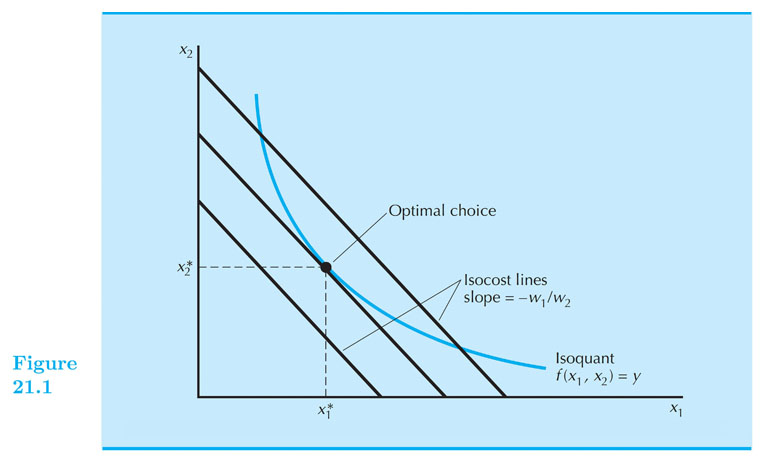
-
What if prices of factors change?
-
What if target output changes?
Cost-minimization problem - The Math
$$ \underset{L,K}{\text{minimize:}} ~ w L + r K \ \text{Subject to:} ~ f(L,K) = q_0 $$
Cost-minimization problem, Case 1: tangency.
-
If technology satisfies mainly convexity and monotonicity then (in most cases) tangency solution!
-
Tangency condition: slope of isoquant equals slope of isocost curve.
- In equation: $ - \frac{w}{r} = - \frac{MP_L}{MP_K} $ (EQ. 1)
-
Constraint: $ q = f(L,K) $ (EQ. 2)
-
System of two equations (Eq1 and Eq2), and two unknowns ($ L $ and $ K $).
Example: Cobb-Douglass
If $ q = f(L,K) = L K $,
$$ L^{*}(w,r,q) = \big( \frac{ q r }{ w } \big)^{1/2} $$
$$ K^{*}(w,r,q) = \big( \frac{ q w }{ r } \big)^{1/2} $$
$$ c(w,r,q) = wL^\star + r K^\star = 2( q r w )^{1/2} $$
Home exercise: solve the more general case:
- $ q = f(L,K) = A ~ L^{a} K^{b} $
- Find $ ~ c(w,r,q) = ?????? $
Cost-minimization problem, Case 2: Corner Solution.
Mainly, but not exclusively:
- Perfect Substitutes:
$$ q = f(L,K) = a L + b K $$
- For example: $ q = f(L,K) = L + K $
Example: Linear technology (1)
$$ q = f(L,K) = a L + b K $$
-
Compare TRS $ ( - \frac{ a }{ b }) $ Vs. slope of the isocosts $ ( - \frac{ w }{ r } ) $
-
Alternatively, compare: $ \frac{ a }{ w } $ Vs. $ \frac{ b }{ r } $
-
If $ \frac{ a }{ w } > \frac{ b }{ r } $ firm should use labor only.
-
If $ \frac{ a }{ w } < \frac{ b }{ r } $ firm should use capital only.
-
If $ \frac{ a }{ w } = \frac{ b }{ r } $ any point along the isoquant, minimizes cost.
-
Example: Linear technology (2)
IF $ \frac{ a }{ w } > \frac{ b }{ r } $
The firm should use only Labor (corner solution).
-
Then: $ q = a L $ , so $ L^*(w,r,q) = \frac{ q }{ a } $
-
Then: $ K^*(w,r,q) = 0 $
-
Then: $ c(w,r,q) = w L^\star = \frac{ w }{ a } q $
Example: Linear technology (3)
IF $ \frac{ a }{ w } < \frac{ b }{ r } $
The firm should use only Capital (corner solution).
-
Then: $ q = b K $ , so $ K^*(w,r,q) = \frac{ q }{ b } $
-
Then: $ L^*(w,r,q) = 0 $
-
Then: $ c(w,r,q) = r K^\star = \frac{ r }{ b } q $
-
IF $ \frac{ a }{ w } = \frac{ b }{ r } $, any point along the isoquant, minimizes cost.
Example: Linear technology (4)
Putting all this together:
$$ c(w,r,q)= q \times \begin{cases} \frac{ w }{ a },& \text{if} ~ \frac{ w }{ a } \leq \frac{ r }{ b }\\ \frac{ r }{ b },& \text{if} ~ \frac{ r }{ b } < \frac{ w }{ a } \end{cases} $$
This can be written as:
$$ c(w,r,q) = q ~ \textrm{min} \{ \frac{ w }{ a } , \frac{ r }{ b } \} $$
Simpler example:
If $ q = f(L,K) = L + K $, then:
$$ c(w,r,q) = q \times \textrm{min} \{ w,r \} $$
Cost-minimization problem, Case 3: Kink Solution
-
Perfect Complements (kink solution): $$ q = f(L,K) = \text{min} \{ \frac{L}{a} , \frac{K}{b} \} $$
-
if $ q = f(L,K) = \textrm{min} \{ L ,K \} $, then:
$$ c(w,r,q) = (w + r)q $$
Conditional factor demand functions
-
Optimal choices of factors are called the conditional factor demand functions
- That is: $ L^* = L(w,r,q_0) $ and $ K^* = K(w,r,q_0) $
-
Optimal cost is the cost function
- That is: $ c(w,r,q_0) = w L(w,r,q_0) + r K(w,r,q_0) $
-
Notice: all this is in the "long run" because we are able to adjust all inputs.
Short-run conditional demand for labor, cost function
-
$ K = \bar{K} $
-
do the graph!
-
Short-run conditional demand of labor: $ L = L(w,r,q, \bar{K}) $
-
This demand is obtained from solving L from $ q = f( \bar{K}, L) $
-
If there are no other inputs it does not depend on prices of inputs.
Short-run - example
-
$ q = f(L, K) = K^{0.5} L^{0.5} $
-
$ K = \bar{K} $
-
$ L^{SR} = \frac{ q^2 }{ \bar{K} } $
-
$ c^{SR}(w,r,q, \bar{K}) = w \frac{ q^2 }{ \bar{K} } + r \bar{K} $