Utility
Intermediate Microeconomics (Econ 100A)
UCSC
One additional assumption on preference relations
-
Continuity:
-
A small change in a bundle can only cause small changes to the preference rankings and level.
-
Put differently, if A is preferred to B, then situations suitably close to A must also be preferred to B.
-
Utility Function
-
Main idea: instead of preference relations, we can describe a consumers' preferences using utility functions.
-
Intuition: A utility function assigns a "satisfaction level" (a number) to each alternative or bundle.
-
Instead of saying: $ iPhone7 \succ Galaxy8 $, we say $ U(iPhone7) > U(Galaxy8) $
-
Instead of saying: $ (2 \textrm{ Beers}, 3 \textrm{ Pizzas} ) \succ (1 \textrm{ Beers}, 4 \textrm{ Pizzas} ) $, we say $ U(2, 3) > U(1, 4) $
Utility Function
-
But, how does a preference relations and a utility function connect?
-
If a consumer's preference relations are:
- complete,
- transitive,
- continuous
-
Then, these preferences can be represented by a (continuous) utility function.
-
Note on reflexivity, monotonicity, convexity.
Utility Function
-
When do we say that we a utility function represents someone's preference relations?
-
A utility function $ U(x) $ represents a preference relation $ \succsim $ when:
-
$ x’ \succ x’’ \iff U(x’) > U(x’’), ~~ $ for any $ x' $ and $ x'' $
-
$ x’ \succsim x’’ \iff U(x’) \geq U(x’’) ~~ $, for any $ x' $ and $ x'' $
-
$ x’ \sim x’’ \iff U(x’) = U(x’), ~~ $ for any $ x' $ and $ x'' $
-
-
Intuitively, $ U(\cdot) $ represents a preference relation if it yields the same ranking of alternatives.
Utility Function
-
That is, like preference relations, utility is an ordinal (i.e. ordering) concept.
-
If, for example, $ U(x) = 6 $ and $ U(y) = 2 $ then bundle $ x $ is strictly preferred to bundle $ y $. But we cannot say: " $ x $ is preferred three times as much as is $ y $ ".
Utility Functions & Indifference Curves
-
An indifference curve contains equally preferred bundles.
-
In terms of utility, all bundles in an indifference curve give the same utility level:
- If $ x \sim y $, $ \iff $ $ U(x) = U(y) $.
-
In other words, indifference curves are the level curves of utility functions.
Utility Functions & Indiff. Curves - Example!
$ u(x_1, x_2) = x_1 ~ x_2 $
Utility Functions & Indifference Curves
- A more complete collection of indifference curves describes more fully the consumer’s preferences (aka indifference map).
Utility functions (are not unique)
-
The preferences of a certain consumer can be described/represented by more than one utility function.
-
That is, there is no unique utility function for a preference relation.
-
Two utility functions $ U() $ and $ V() $ represent the same preferences, if we can obtain $ V() $ by applying a strictly increasing function on $U()$:
-
That is, if we can write $ V = f( U() ) $ where $ f() $ is strictly increasing.
-
[ ask students about strictly increasing functions ]
Utility functions (are not unique) - Example 1!
-
Suppose $ U(x_1,x_2) = x_1 x_2 $ represents some preferences.
-
You have bundles $ (4,1), (2,3) $ and $ (2,2) $.
-
Under this utility function: $ U(2,3) = 6 > U(4,1) = U(2,2) = 4 $;
-
Therefore, we know that: $ (2,3) \succ (4,1) \sim (2,2) $.
Utility functions (are not unique) - Example 1!
-
Suppose we define $ V = U^2 $.
-
Then, $ V(x_1,x_2) = (x_1 x_2)^2 = x_1^2 x_2^2 \quad $
-
...and so, $ V(2,3) = 36 > V(4,1) = V(2,2) = 16 $
-
SO! again $ (2,3) \succ (4,1) \sim (2,2) $.
-
That is, $ V() $ preserves the same order as $ U() $ and therefore represents the same preferences.
Utility functions (are not unique) - Example 2!
-
Suppose we define $ W = 2U + 10 $.
-
Then, $ W(x_1,x_2) = 2 (x_1 x_2) + 10 $
-
...and so, $ W(2,3) = 22 > W(4,1) = W(2,2) = 18 $
-
SO! again! $ (2,3) \succ (4,1) \sim (2,2) $.
-
That is, $ W() $ preserves the same order as $ U() $ and therefore represents the same preferences.
Goods, Bads and Neutrals
-
A good is a commodity unit which increases utility (gives a more preferred bundle).
-
A bad is a commodity unit which decreases utility (gives a less preferred bundle).
-
A neutral is a commodity unit which does not change utility (gives an equally preferred bundle).
-
For home: Draw indifference curves for each of them
Drawing an Indifference Curve
-
Identify the utility function: $ U(x_1, x_2) $.
-
Set the utility level to a constant level $ k $: $ U(x_1, x_2) = k $.
-
Solve for $ x_2 $ in the previous equation to obtain a generic indifference curve.
-
Give $ k $ an arbitrary value and draw the curve.
-
To draw another curve, set $ k $ equal to another value and draw again.
Drawing an Indifference Curve - Example!
-
Utility: $ U(x_1, x_2) = x_1^{0.5} x_2 $
-
Utility at a constant level: $ x_1^{0.5} x_2 = k $
-
Solve for $x_2$: $ x_2 = \frac{k}{x_1^{0.5}} $.
-
Give $ k $ a value: $ x_2 = \frac{ 10 }{x_1^{0.5}} $. Draw!
-
Give $ k $ another value: $ x_2 = \frac{ 20 }{x_1^{0.5}} $. Draw!
-
Try with other functions... for example: $ U(x_1, x_2) = x_1 + x_2^{0.5} $
Typical utility fns: perfect substitutes
-
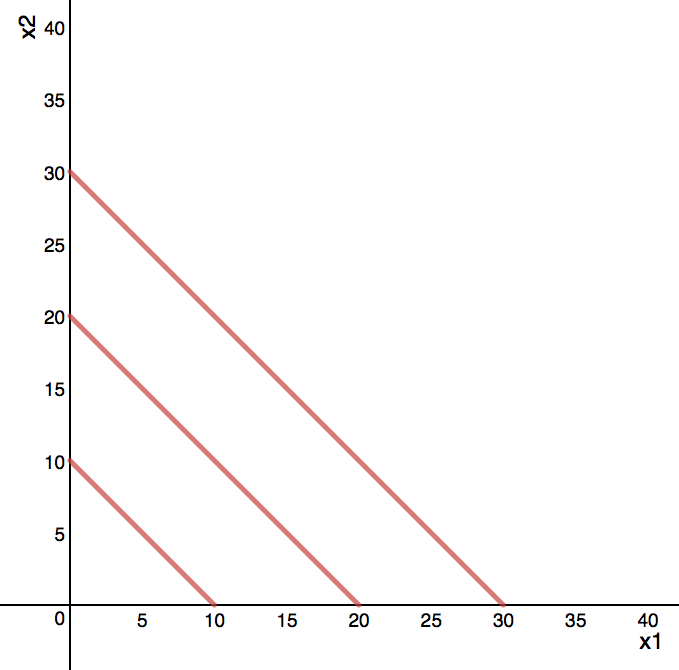
General: $ ~ U(x_1,x_2) = \alpha x_1 + \beta x_2 ~~ $, for $ \alpha, \beta > 0 $
-
Example: $ ~ U(x_1,x_2) = x_1 + x_2 $
Typical utility fns: perfect substitutes
Typical utility fns: perfect complements
-
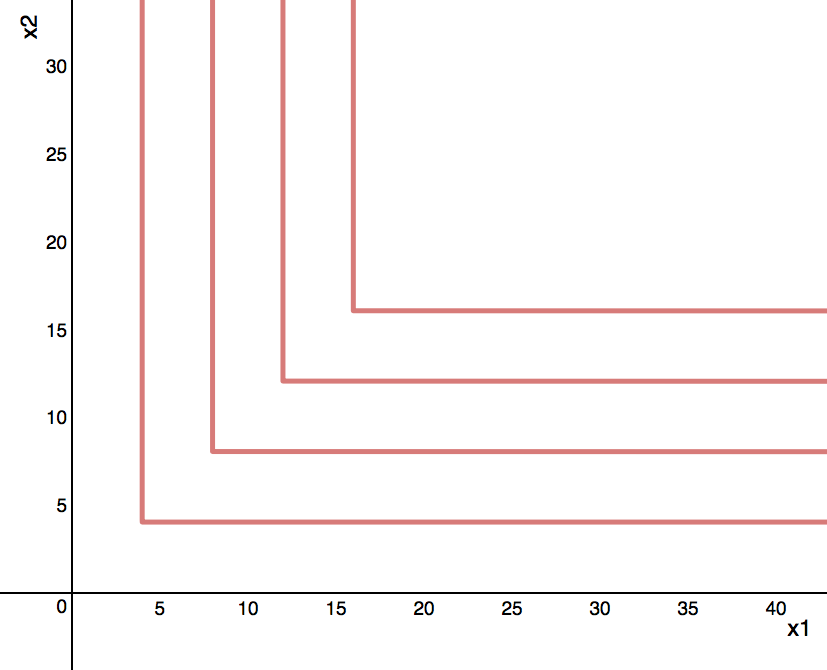
General: $ ~ U(x_1,x_2) = \textrm{min} \{ \frac{x_1}{\alpha}, \frac{x_2}{\beta} \} ~~ $, for $ \alpha, \beta > 0 $.
-
Example: $ ~ U = \textrm{min} \{ x_1, x_2 \} ~~ $
Typical utility fns: perfect complements
Typical utility fns: Cobb-Douglas
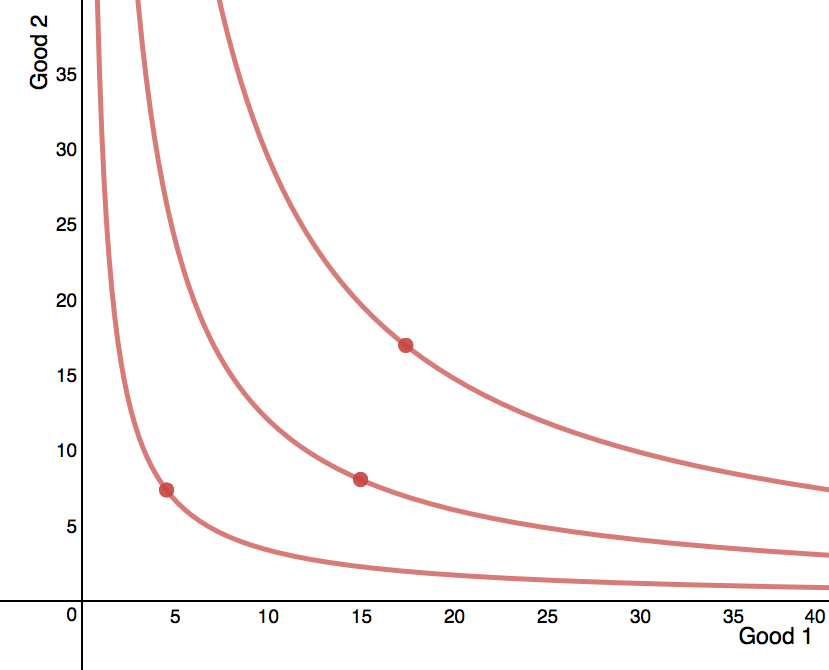
General $ U(x_1,x_2) = x_1^a x_2^b $ with $a > 0$ and $b > 0$
Examples:
-
$ U(x_1,x_2) = x_1^{0.5} x_2^{0.5} \quad $ (that is, $ a = b = 1/2 $)
-
$ U(x_1,x_2) = x_1 x_2^3 \quad $ (that is, $ a = 1, b = 3 $)
-
$ U(x_1,x_2) = x_1^{2} x_2^{0.75} \quad $ (that is, $ a = 2, b = 0.75 $)
Typical utility fns: Cobb-Douglas
Marginal Utility
-
Marginal means “incremental”.
-
The marginal utility of commodity $ x_1 $ is the rate-of-change of total utility as the quantity of commodity $ x_1 $ consumed increases.
-
$ MU_{x_1} = \frac{\partial U}{\partial x_1} $ and $ MU_{x_2} = \frac{\partial U}{\partial x_2} $
-
To know whether $ MU_{x_1} $ is increasing or decreasing in $ x_1 $, we take the derivative of $ MU_{x_1} $ with respect to $ x_1 $. That is, we calculate: $ \frac{\partial MU_{x_1}}{\partial x_1} $
Marginal Utilities - Cobb-Douglas Example!
Utility: $ U(x_1,x_2) = x_1^{0.5} x_2^2 $
Marginal Utilities:
$ MU_{x_1} = \frac{\partial U}{\partial x_1} = 0.5 x_1^{-0.5} x_2^2 $
$ MU_{x_2} = \frac{\partial U}{\partial x_2} = 2 x_1^{0.5} x_2^1 $
Marginal Utilities - Perf. Substitutes Example!
Utility: $ U(x_1,x_2) = a x_1 + b x_2 $
Marginal Utilities:
$ MU_{x_1} = \frac{\partial U}{\partial x_1} = a $
$ MU_{x_2} = \frac{\partial U}{\partial x_2} = b $
Marginal Utilities - Perf. Complements Example!
-
Utility: $ U(x_1,x_2) = min \{ x_1 , x_2 \} $
- Not differentiable at the kinks.
Marginal Utilities and the MRS
Claim: $ MRS \equiv \frac{d x_2}{d x_1} = - \frac{ MU_{x_1} }{ MU_{x_2} } $
Here is the math:
-
Remember, the equation for an indifference curve is: $ U(x_1,x_2) = k $, where satisfaction, $ k $, is a constant.
-
Do total differentiation: $ \frac{\partial U}{\partial x_1} d x_1 +
\frac{\partial U}{\partial x_2} d x_2 = d k $, -
But $ dk = 0 $ since $ k $ is a constant, and $ \frac{\partial U}{\partial x_i} $ can be replaced by $ MU_{x_i} $. That is: $ MU_{x_1} d x_1 + MU_{x_2} d x_2 = 0 $
-
We solve for $ \frac{d x_2}{d x_1} $ and we get: $ \frac{d x_2}{d x_1} = - \frac{ MU_{x_1} }{ MU_{x_2} } $
Marginal Utilities and the MRS - Examples:
- If $ U = x_1^{2} x_2 $,
-
Then: $ MRS = - \frac{MU_{x_1}}{MU_{x_2}} = $ $ - \frac{2 x_1 x_2}{ x_1^2 } = $ $ - 2 \frac{ x_2 }{ x_1 } $
-
If $ U = x_1 x_2^{0.5} $,
-
Then: $ MRS = - \frac{MU_{x_1}}{MU_{x_2}} = $ $ - \frac{x_2^{0.5}}{ x_1 0.5 x_2^{-0.5}} = $ $ - 2 \frac{ x_2 }{ x_1 } $
-
If $ U = x_1 + 5 x_2 $,
- Then: $ MRS = - 1/5 $